Exposed Aggregate Concrete for Driveways and Entryways Frankston North
Professional Exposed Aggregate Installation and Restoration
Just about 37 km south of Melbourne CBD, Frankston North is a residential suburb undergoing community renewal with good access to amenities. Outdoor living is a big part of life in Frankston North, making durable surface finishes a practical investment. With the range of properties across Frankston North, exposed aggregate provides a versatile surface finish that works with any architectural style. Notable local features include Frankston Nature Conservation Reserve, Mahogany Rise shops, and Monterey Secondary College. You’ll find older public and private housing stock alongside newer infill development throughout the suburb.
Exposed aggregate concrete delivers a durable, slip-resistant finish that reveals natural stone textures beneath the cement surface—combining structural performance with decorative appeal for Melbourne properties.
Nupave specialises in exposed aggregate installation and restoration across Melbourne, the Mornington Peninsula, Bass Coast, Phillip Island, and surrounding regions. Our team handles everything from new driveways and pool surrounds to commercial flooring projects, using locally sourced aggregates and installation methods that meet Australian Standards.
Why Exposed Aggregate Concrete is Perfect for Melbourne Properties
Low Maintenance Requirements When Properly Sealed
Exposed aggregate concrete requires relatively low maintenance compared to many alternative exterior materials when the surface is properly sealed after installation. The primary ongoing requirement is periodic resealing—typically every two to three years, though high-traffic areas or surfaces with significant UV exposure may benefit from more frequent attention. This resealing protects against staining, helps resist water penetration, and maintains the visual enhancement that quality sealers provide.
General cleaning involves hosing down the surface and occasional washing with mild detergent to remove accumulated dirt, leaves, and other contaminants. Pressure washing can be used but should be applied at lower pressure settings and appropriate angles to avoid dislodging aggregate or damaging the sealer layer. Oil stains and spills should be cleaned promptly to prevent absorption into the concrete matrix.
Compared to pavers—which require joint sand replenishment, weed control, and periodic realignment—exposed aggregate presents fewer maintenance tasks. The continuous surface eliminates joints where weeds establish and where ants create sand displacement. Compared to timber decking or other materials requiring annual treatments, exposed aggregate offers a more straightforward maintenance schedule focused primarily on cleaning and periodic sealing.
At Nupave, our commitment to our customers doesn’t end once the job is complete. We understand that life gets busy, and important maintenance like resealing can easily be overlooked. That’s why we’ve created a simple care plan system, where your project is added to our register and you receive timely reminders when your concrete is due for resealing. There’s no cost for this service — it’s simply part of how we look after our clients and help protect their investment long-term. By staying on top of maintenance, your surface continues to perform and look its best for years to come, without you having to keep track of it yourself.
What Exposed Aggregate Concrete Is and How It’s Created
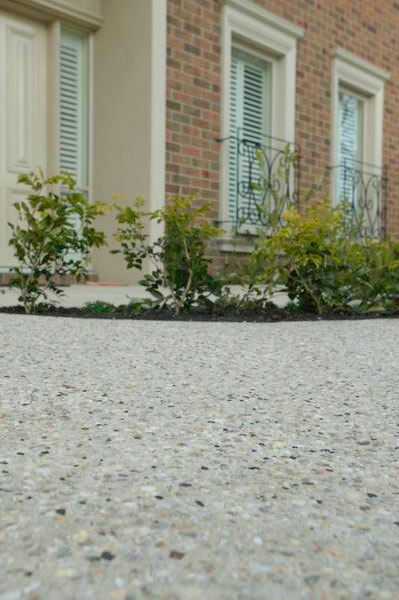
Exposed aggregate concrete is a decorative concrete finish created by removing the top layer of cement paste to reveal the natural stone, pebbles, and gravel embedded within the mix. This process produces a textured, visually distinctive surface that differs significantly from plain finished concrete. The aggregate—whether basalt, granite, river pebbles, or crushed quartz—becomes the dominant visual element, creating surfaces that range from subtle stone exposure to pronounced decorative textures depending on the desired appearance.
Unlike standard concrete where the aggregate remains hidden beneath a smooth cement surface, exposed aggregate incorporates natural stones as a visible design feature. The variation in stone size, shape, and colour allows for a customised appearance, with each installation carrying a unique character determined by the specific aggregate blend selected. This method has been used in Melbourne for decades, with local suppliers offering aggregate options sourced from Victorian quarries—primarily basalt from the Newer and Older Volcanics geological formations, along with granite and sedimentary rock materials.
The finish is achieved through a controlled washing process where the surface layer of concrete is exposed at a precise timing window. Surface retarders are applied to delay cement paste hardening on the top layer, allowing contractors to wash away the cement and reveal the underlying aggregate without dislodging the stones. This technique requires careful control—exposure too early risks aggregate loss, while waiting too long makes the cement paste difficult to remove. The result is a surface where approximately one-third of the smallest aggregate size becomes visible, creating the characteristic textured appearance.
Visual Appeal and Customisation Options
Exposed aggregate offers strong visual appeal through the natural beauty of stone, rather than relying on artificial colours or patterns. With a wide range of aggregates available—such as basalt, granite, and river pebbles—finishes can be tailored to suit different home styles and outdoor spaces. Variations in stone size and blend allow for further customisation, creating anything from subtle, refined textures to more pronounced, decorative finishes.
Our Exposed Aggregate Services
Residential Exposed Aggregate
We create custom exposed aggregate installations for residential properties throughout Melbourne and surrounding areas. New driveways benefit from aggregate selection tailored to complement house colours and landscaping, with slab thickness and reinforcement designed for household vehicle loads and local soil conditions.
Pathways, patios, and outdoor entertaining areas receive the same attention to design and construction detail. Pool surrounds utilise aggregate types selected for barefoot comfort and slip resistance, with drainage slopes directing water away from the pool edge and house foundations.
Exposed aggregate resurfacing provides an option for existing concrete surfaces in sound structural condition. This overlay approach can transform plain or deteriorating concrete into attractive exposed aggregate finishes without the full excavation and base preparation required for new installations. Our consultation process assesses whether resurfacing is appropriate for each specific situation based on existing concrete condition and intended use.
Commercial Exposed Aggregate Flooring
Exposed aggregate is well suited to commercial applications, offering a durable, low-maintenance surface that performs under high pedestrian traffic while maintaining a professional appearance. It is commonly used for entrances, walkways, and outdoor areas, with finishes selected to align with the overall site design. When specified and installed correctly, it meets relevant standards and provides a long-lasting solution for both private and public spaces.
Is New Concrete Always Necessary?
Before investing in a brand new exposed aggregate driveway, it’s important to understand whether your existing concrete can be improved rather than replaced. Many surfaces that look beyond repair can often be transformed using alternative methods, avoiding the need for costly excavation. A professional inspection can give you a clear answer and help you avoid unnecessary expenses while still achieving a high-end result.
Many homeowners assume that worn or dated concrete needs to be completely replaced, but that isn’t always the case. Before committing to new exposed aggregate, a proper assessment can determine whether the existing slab is suitable for improvement rather than removal. This approach can reduce costs, minimise disruption, and still deliver a high-quality finish.
We’re happy to assess your concrete and give you an honest answer
Exposed Aggregate Applications Across Melbourne
Driveways for Modern and Traditional Melbourne Homes
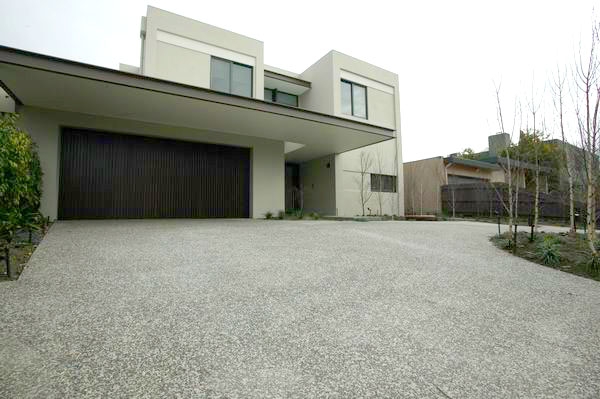
Exposed aggregate is commonly used for driveways where both durability and appearance are important. Its ability to handle vehicle traffic while maintaining a decorative finish makes it a reliable option.
Pathways and Entry Areas for Enhanced Curb Appeal
Exposed aggregate pathways and entry areas enhance curb appeal by creating a strong visual connection between the street and the home. With a range of finishes available, the surface can be tailored to complement surrounding materials and landscaping. At the same time, it provides a durable, low-maintenance solution that handles daily foot traffic while maintaining its appearance over time.
Frequently Asked Questions
How long does exposed aggregate concrete last?
When installed correctly and properly maintained, exposed aggregate concrete can last for many years. Its durability makes it suitable for high-traffic areas such as driveways and outdoor spaces.
What maintenance does exposed aggregate require?
Exposed aggregate maintenance focuses on cleaning and periodic resealing. Regular cleaning involves hosing off accumulated debris, occasional washing with mild detergent for stubborn dirt, and prompt attention to oil or chemical spills that might stain if left untreated.
Resealing is recommended every two to three years for residential installations, with more frequent attention for commercial areas or surfaces with high UV exposure. The sealer protects against water penetration, resists staining, and enhances aggregate colour appearance. Quality penetrating or surface sealers with UV stabilisers extend this protection between applications.
Avoid high-pressure washing at extreme settings, which can dislodge aggregate or damage sealer coatings. Standard pressure settings with appropriate nozzle distance are sufficient for effective cleaning without surface damage.
Is exposed aggregate suitable for Melbourne’s weather?
Exposed aggregate performs well in Melbourne’s climate conditions. The natural stone aggregates resist UV degradation that affects coloured or stamped concrete treatments. The textured surface provides reliable traction during wet weather—valuable given Melbourne’s rainfall distribution throughout the year.
Temperature variations in Melbourne rarely approach freeze-thaw conditions that damage concrete in colder climates, reducing one potential deterioration mechanism. Proper installation with attention to drainage prevents water ponding that might cause localised deterioration. The slip resistant properties suit Melbourne’s frequent rain events, maintaining safety for pedestrians and vehicle traction for driveways.
Coastal areas within our service region require attention to salt exposure, with appropriate sealer selection for marine environments.
Is resurfacing an option before installing new exposed aggregate?
Before committing to new exposed aggregate concrete, it’s worth checking whether resurfacing is a viable alternative. Many surfaces can be upgraded at a lower cost, making it important to assess the existing concrete before deciding on full replacement.
What is exposed aggregate concrete?
Exposed aggregate concrete is a decorative finish where the top layer of cement is removed to reveal the natural stones within the mix. This creates a textured, durable surface commonly used for driveways, pathways, and outdoor areas.
Our Professional Installation Process
Step 1: Site Assessment and Design
Every exposed aggregate project begins with onsite evaluation of existing conditions. This assessment covers soil characteristics—particularly important in Melbourne where reactive clay soils are common and require specific preparation approaches. Drainage requirements, access constraints, existing services, and slope conditions inform both design and construction planning.
Aggregate selection occurs during this consultation phase. We present samples of available aggregate types and blends, discussing how different options suit your property’s architecture, landscaping, and intended use. Colour coordination with house materials, preferred texture levels, and budget considerations guide the final aggregate specification.
Step 2: Preparation and Base Work
Proper preparation determines long-term performance. Excavation removes existing material to required depth, accounting for base layer thickness, concrete slab depth, and finished surface level relative to surrounding elements. In reactive soil areas, additional depth or moisture management measures may be incorporated.
Base preparation involves placing and compacting crushed rock to create a stable foundation. Compaction achieves approximately 95% Modified Proctor density to prevent future settlement. Reinforcement installation—typically steel mesh for residential applications or bar reinforcement for heavy-duty commercial use—provides tensile strength to resist cracking under load and thermal movement.
Formwork establishes edge profiles and levels, with careful attention to drainage falls directing water away from buildings and towards appropriate discharge points. Control joint locations are planned during this phase, positioning cuts to accommodate shrinkage cracking at predetermined locations rather than allowing random crack development.
Step 3: Concrete Pour and Finishing
Concrete placement requires coordination with batch plant delivery schedules and site readiness. The mix specification—strength grade, aggregate size, slump, and any admixtures—follows AS 1379 requirements appropriate to the project. Common specifications include N32 or N40 grades with 20mm maximum aggregate size for residential driveways.
Placement, spreading, and initial levelling occur immediately following delivery. Bull float and finishing tools work the surface to achieve correct levels while consolidating the concrete without segregating the aggregate. The timing of subsequent operations depends on ambient temperature, humidity, and mix characteristics.
Surface retarder application must occur within specific time windows—typically when the concrete has firmed sufficiently to walk on but before the surface cement paste hardens fully. This retarder delays paste set at the surface while allowing the underlying concrete to continue curing, creating the differential hardening that enables controlled aggregate exposure.
Step 4: Cleaning, Sealing and Protection
The washing process removes retarder-affected cement paste to reveal the aggregate beneath. Timing is critical—typically 4 to 24 hours after placement depending on conditions and retarder type. Pressure washing at appropriate settings removes the paste layer without dislodging aggregate or creating uneven exposure.
Once washed and allowed to dry, the surface receives protective sealer application. Quality sealers penetrate the concrete surface and coat the exposed aggregate, protecting against oil stains, water absorption, and UV effects while enhancing the natural stone colours. Full cure of both concrete and sealer typically requires several days before the surface can accept vehicle traffic.
Ongoing protection depends on periodic resealing—typically every two to three years—and prompt attention to any stains or spills that could penetrate the sealer layer.
Get Your Free Exposed Aggregate Quote Today
Service Areas
Nupave provides exposed aggregate installation and restoration services throughout Melbourne metropolitan areas and the broader region:
Melbourne Metropolitan – All suburbs including eastern, western, northern, and southern Melbourne
Mornington Peninsula – From Frankston to Portsea and surrounding areas
Bass Coast and Phillip Island – Coastal properties and township locations
West and South Gippsland – Regional service for residential and commercial projects
Our team provides free onsite quotations including site assessment, aggregate selection consultation, and detailed project pricing. We can present aggregate samples and discuss design options appropriate to your property and requirements.
Phone: Contact our office to schedule your consultation
Service commitment: Professional installation to Australian Standards with quality local aggregates
Frankston North’s post-war housing stock and compact blocks often come with original driveways that have done decades of service. Rather than replacing a solid slab, concrete resurfacing in Frankston North can deliver a similar decorative effect at a fraction of the cost. In neighbouring areas including Carrum Downs, exposed finishes remain a popular choice for driveways and entertaining areas alike. We handle exposed aggregate concrete across Melbourne installs throughout the City of Frankston.